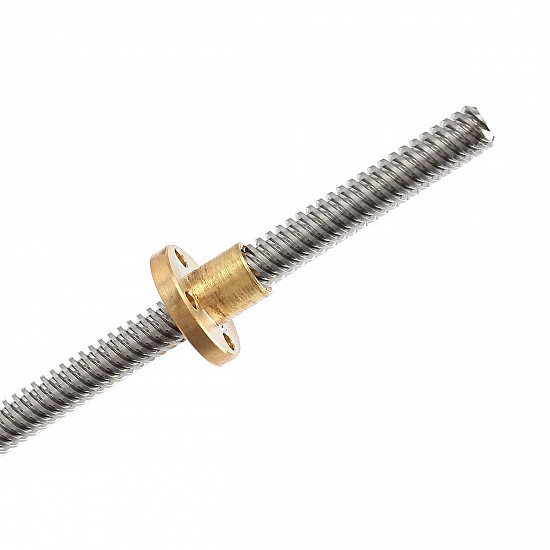
An industrial lead screw is a precision mechanical component used to convert rotational motion into accurate linear movement. It offers smooth travel, high positional accuracy, and reliable performance in automated systems. Moreover, lead screws are essential in applications that require stable and controlled linear motion.
Lead screws are available in trapezoidal, ACME, and metric thread designs. In addition, they are manufactured from strong materials such as stainless steel, carbon steel, and alloy steel. These materials ensure excellent durability and long service life under continuous load. Lead screws operate quietly and deliver consistent performance, even in demanding environments.
They are widely used in CNC machines, 3D printers, automation systems, robotics, medical devices, packaging machines, and laboratory instruments. For example, engineers use industrial lead screws for precise positioning, lifting mechanisms, adjustment units, and movement control. The screw threads provide firm grip and prevent backlash, which maintains accuracy throughout operation. Consequently, industries rely on lead screws for reliable linear motion.
Lead screws work with nuts made from bronze, plastic, or stainless steel. These nuts reduce friction and enable smooth sliding movement. Furthermore, the system requires low maintenance and offers long-term operational stability. Lead screw assemblies are easy to install, align, and integrate with motors or mechanical frames.
Their self-locking nature prevents unintentional movement, which increases safety and control. They also resist vibration and handle rotational loads effectively. Industrial lead screws support heavy duty applications without losing accuracy. Overall, an industrial lead screw offers precision, durability, and smooth linear performance for modern machinery and automation systems.