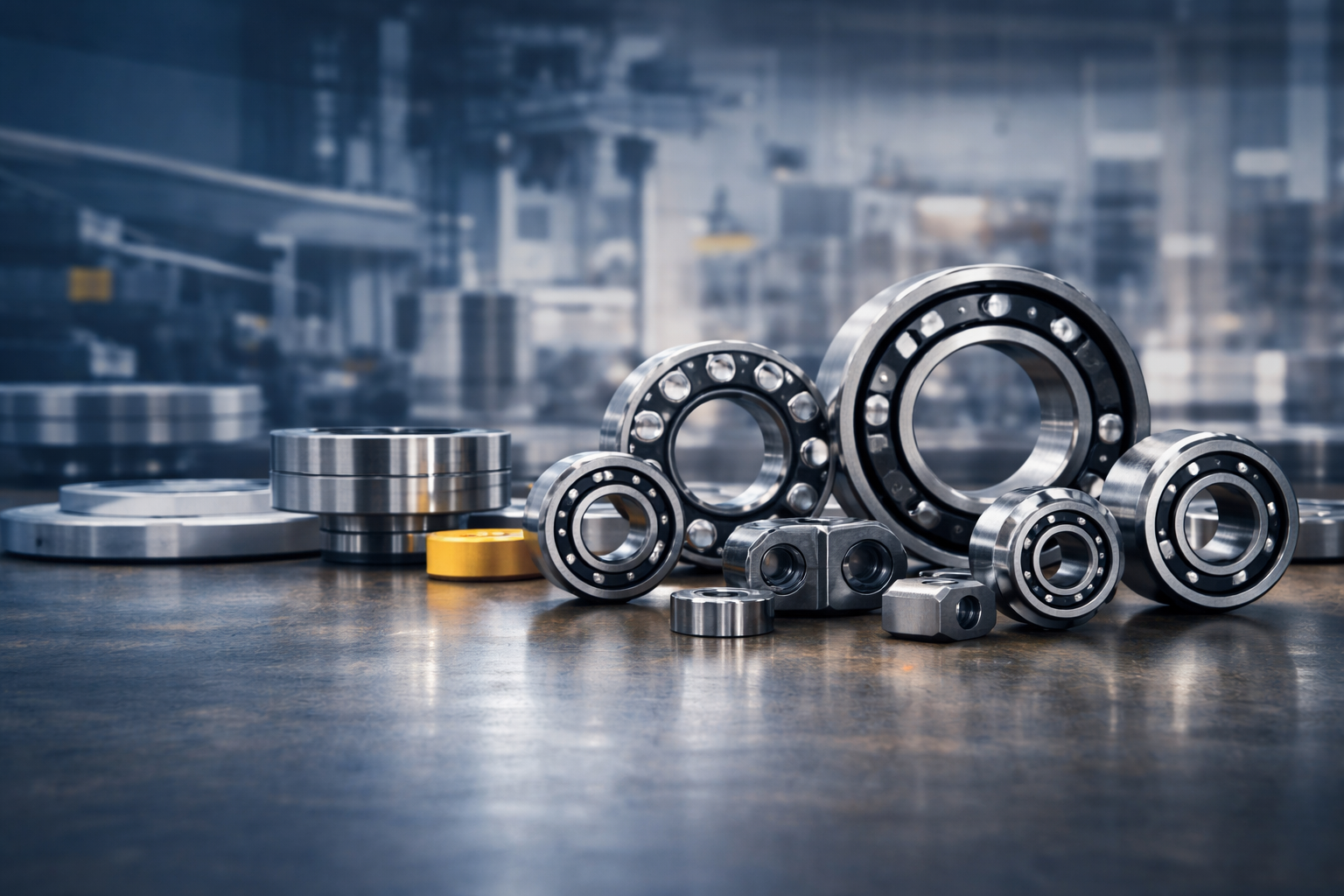
In modern manufacturing and heavy-duty industrial operations, bearings play a critical role in ensuring smooth motion, reducing friction, and supporting loads. Selecting the right bearing is not just a technical decision—it directly affects machine performance, operating cost, reliability, and service life.
Understanding the Role of Bearings in Industry
Bearings are mechanical components designed to constrain relative motion between parts, typically allowing rotational or linear movement while minimizing friction. In industries such as automotive, packaging, steel, textile, cement, and heavy engineering, bearings are essential for motors, conveyors, pumps, gearboxes, and rotating equipment.
1. Identify the Type of Load
The first and most important factor in bearing selection is understanding the type of load the bearing will experience.
Radial Load
Radial loads act perpendicular to the shaft axis.
Applications: Electric motors, conveyors, fans.
Recommended bearings: Deep groove ball bearings, cylindrical roller bearings.
Axial (Thrust) Load
Axial loads act parallel to the shaft axis.
Applications: Vertical pumps, gear assemblies.
Recommended bearings: Thrust ball bearings, thrust roller bearings.
Combined Load
Many industrial applications experience both radial and axial loads.
Recommended bearings: Angular contact ball bearings, tapered roller bearings.
2. Consider Load Capacity and Bearing Size
Load capacity defines how much weight a bearing can handle safely. Selecting an undersized bearing may result in early fatigue, while oversized bearings increase cost and space requirements.
Key points:
- Static load rating
- Dynamic load rating
- Safety factors for vibration and shock loads
3. Evaluate Operating Speed
Every bearing has a maximum speed limit. Exceeding this limit can cause heat generation, lubricant breakdown, and failure.
- High-speed applications: Deep groove & angular contact bearings
- Low-speed, heavy load: Spherical & tapered roller bearings
4. Assess Operating Environment
Industrial environments affect bearing life significantly.
- High temperature: Heat-resistant bearings + high-temp grease
- Dusty areas: Sealed or shielded bearings
- Wet/corrosive: Stainless steel or coated bearings
5. Choose the Right Bearing Material
- Chrome steel: Standard industrial use
- Stainless steel: Corrosion resistance
- Ceramic hybrid: High speed, low friction
6. Sealing and Lubrication
- Open, shielded, or sealed bearings
- Grease or oil lubrication depending on speed and temperature
7. Mounting and Maintenance
Correct installation and periodic inspection improve bearing life.
Tips:
- Proper shaft tolerance
- Correct mounting tools
- Regular lubrication schedule
Industry-Specific Bearing Selection
- Automotive: Precision & vibration resistance
- Packaging: High speed & low noise
- Heavy Engineering: Shock load resistance
Why Choose SS Sales Corporation?
- Trusted industrial bearing solutions
- Expert technical support
- Wide product range
- Reliable after-sales service
Conclusion
Choosing the right bearing improves productivity, reliability, and cost efficiency. Understanding operating conditions and consulting experts ensures long-term performance.
📞 Contact SS Sales Corporation for professional bearing selection support.